
NE1 Reviews: To Kill a Mockingbird
We review To Kill a Mockingbird at Newcastle Theatre Royal
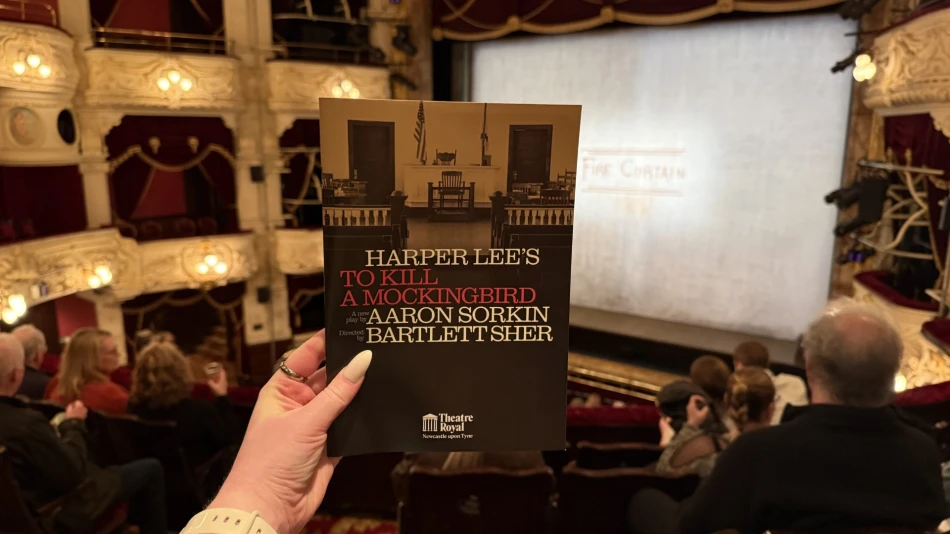
Picture everything you know about Harper Lee’s seminal novel "To Kill a Mockingbird." Atticus Finch and his unshakeable morals. The defamation of Boo Radley’s character. Calpurnia’s reserved, maternal presence as the Finches’ longtime maid.
And now… forget it. Because regardless of how you first explored the text – whether through Lee’s writing or the award-winning 1962 film – Aaron Sorkin’s stage adaptation will leave you reeling.
Sorkin’s adaptation first took to the stage on Broadway back in 2018, but you needn’t fly all the way to the Big Apple to catch the production nowadays. Newcastle’s very own Theatre Royal is playing host to the Olivier Award-nominated To Kill a Mockingbird until Saturday 25th April, and it's here that we caught the initial performance of its run.
But first – let’s take a visit to Maycomb, Alabama. Or at least, how Lee imagined it. Her 1960 novel followed lawyer Atticus Finch, and his work to defend Tom Robinson, an innocent black man accused of rape, in the courtroom of the novel’s fictional American South town, where the effects of Jim Crow segregation linger. Atticus’ youngest daughter Scout recounts the events of this trial, and the summer surrounding it. Her privileged perspective idealises Atticus as a “hero” fighting for racial injustice, and an unrelenting optimism about his fellow townsfolk. “You never really understand a person until you consider things from his point of view,” he always repeats, “until you climb into his skin and walk around in it.”

Masterfully, Aaron Sorkin has adapted the text for our times without losing the youthful naivety that makes Scout who she is. The novel remains narrated by her on-stage in fact, alongside brother Jem and friend Dill, who address the audience with unwavering energy and enthusiasm, so much so that you can’t help but feel the pull to join them on this journey.
But to counter the "heroic" narrative of Atticus in the original story, Sorkin instead makes the Finch father a protgaonist, and in the wonderful world of literature, that means he has to have a fatal flaw. And in fact, Sorkin actually picks the flaw that “Harper Lee already gave, which is that he excuses the thing that ought not be excused.” On-stage, he remains neutral in the face of racist and sexist vitriol – even encouraging his children to tolerate it, something almost unthinkable in today's society. The larger role of Calpurnia emphasises the absurdity of this - where Lee positioned her as a maternal figure, educating Scout and Jem about the world around them, Sorkin uses her voice to prove that Atticus’ optimism is a double-edge sword: "Atticus: I believe in being respectful / Calpurnia: No matter who you’re disrespectin’ by doin’ it."
Andrea Davy’s incredible performance as Calpurnia means these moments get all the right reactions from the audience, whether that’s enraptured silence or a cluster of chuckles. One thing’s for sure – Davy and Sorkin’s work combined on-stage shades Atticus in a much-needed new light. And speaking of incredible performances, it’s about time we give Patrick O'Kane his flowers. Embodying Atticus down to the tailoring (we’re sure Gregory Peck would approve), the star is impeccable at embodying the ‘new’ adaptation of one of literature’s most beloved characters, taking his flaws in his stride. Aaron Shosanya also shines as the accused Tom Robinson. From his quiet presence in the courtroom as witnesses verbally abuse him from the stand, to his first meeting with Atticus where he simply wants to be heard, Shosanya builds an understated connection with the audiences that isn’t to be underestimated.
Then there’s Anna Munden, Miss Jean Louise Finch or as we know her, Scout. Her unrelenting energy is infectious, addressing the audience and actors alike with fervour, but even the smallest moments remind us of her youth. That, as Calpurnia puts it, she’s “just a child. You’ve seen some things you shouldn’t a had to yet.” For example, her refusal to sit ‘normally’ on the porch bench – she’ll climb over the side, around the back, but never will she join her father there by simply walking. While Jem and Dill eavesdrop on Atticus from the screen door, it’s not hard to spot Scout creeping around the side of the house on all-fours and hiding behind the foundations. So when Scout enters the courtroom for the first time and Munden recites lines like these, they almost seem to hold extra gravitas: "I imagined that when the bailiff called “All Rise” something large was required of us something stunning, magnificent and rare. […] If justice could be found nowhere else, it would be found here."
And of course, we’d be remiss not to mention the wicked Bob Ewell, played in this production by the talented Oscar Pearce. As writer Afua Hirsch highlights in the programme, Sorkin turns Ewell’s virulent racism and unpleasantness up to the max, “so that he expresses an all too familiar sense of white, racial anxiety.” In fact, Sorkin even used comments from a far-right website to write Bob Ewell’s lines. “And that,” he says, “is how I was able to assure myself that I wasn’t writing about something in our distant past.”
To Kill A Mockingbird also doesn’t take half measures when it comes to set design. The rolling set pieces and props fully immerse you in three different areas throughout the play: the courthouse, the family home, and the streets of Maycomb – each with their own intricacies. But one detail in the former set, the courthouse, really caught our attention. Atticus, Judge Taylor, Horace Gilmer and plenty of other characters make reference to the jury box throughout the trial, speaking to the space. And yet Sorkin’s adaptation sees that side of the stage left empty – their absence emphasising the injustices of Robinson’s case. There is no “point” in a jury, because a guilty verdict was inevitable from the first time the gavel fell.
In times like these, it’s hard not to focus on the political moments of a play like To Kill A Mockingbird. When a novel about racial tensions published in 1960 continues to resonate with readers over sixty years later, it’s obvious that it doesn’t say great things about our society. And yet, masterful as ever, Sorkin has managed to throw a little light in amongst the shade. From Dill’s unnecessarily long introductions (we could all do with some of his confidence, I think!) to the reveal that the town drunk is, in fact, only drinking coca cola, and lets everyone think that he’s an alcoholic so they’ll leave him alone, this brief, bright interludes remind us of the good in their world - and ours.
If you couldn’t tell already, we could write a book on how much we loved this production of To Kill a Mockingbird. Powerful, darkly comic, and unforgettably poignant for our times, this is one you won’t want to miss. Just don’t blame us if you find a tear falling by the time Boo Radley reveals himself…
To Kill a Mockingbird is playing at Newcastle’s Theatre Royal until Saturday 25th April 2026. For more information, including how to book tickets, visit: www.theatreroyal.co.uk/whats-on/to-kill-a-mockingbird/
Image credits: Johan Persson
Want to be in the know about everything that’s happening in Newcastle city centre? Sign up to our newsletter and follow us on Facebook, Instagram, X and TikTok.
Related tags
You may also like
-
 Events Yard Act: NX
 -
 Venues PHO 179
